The Bund: Shanghai’s waterfront through time
The Bund is often introduced as a row of grand old buildings facing a futuristic skyline. Its real story is much bigger: a muddy riverbank turned colonial trading front, financial centre, civic promenade and, eventually, the stage on which Shanghai presents its past and future at once.
From riverbank to treaty-port waterfront
The Chinese name Waitan (外滩) means the outer bank. The English word “Bund” came to Shanghai through British commercial usage in South Asia and referred to an embankment or waterfront. Before it became an address known around the world, this stretch on the west bank of the Huangpu was a low, working river edge outside Shanghai’s walled Chinese city.
Shanghai opened to foreign trade in 1843, after the First Opium War and the Treaty of Nanjing. A British settlement was laid out beside the river soon afterwards; it later joined the American settlement to form the International Settlement in 1863. Wharves, warehouses, trading houses and consulates gathered along the water because the Huangpu connected Shanghai to the Yangtze basin and the sea.
That beginning matters. The Bund’s rise was tied to the unequal-treaty system and foreign extraterritorial power, not simply to glamorous architecture. It was also a place where Chinese compradors, merchants, workers, bankers and migrants helped build a new kind of city. From the start, the waterfront expressed both Shanghai’s global reach and the sharp inequalities behind it.
The skyline of money, 1890s–1930s
Early timber and brick premises gradually gave way to the monumental stone façades seen today. By the early twentieth century the Bund had become one of East Asia’s leading financial streets. Banks, insurance firms, shipping companies and newspaper offices competed for prominent sites and ever more confident headquarters.
The result is not one architectural style but a compressed history of them: neoclassical columns, Baroque domes, Gothic details, Chicago School structure and Art Deco geometry. The former HSBC Building of 1923, the Customs House of 1927, Sassoon House of 1929 and the Bank of China Building of 1937 make the short walk feel like a timeline in stone.
Look past the symmetry and notice the signs of changing technology: steel frames made taller offices possible; elevators changed how upper floors were valued; electric light and clocks ordered the pace of business. The Customs House clock, still sounding over the river, was once both a civic landmark and a reminder that trade ran on precise time.
- 1923 — the new HSBC headquarters opens.
- 1927 — the present Customs House and its clock tower are completed.
- 1929 — Sassoon House and the Cathay Hotel open at Nanjing Road.
- 1937 — the Bank of China Building completes the best-known stretch of the skyline.
The Peace Hotel: one building, several Shanghais
At the corner of the Bund and East Nanjing Road, the building with the green copper pyramid is Sassoon House, home of today’s Fairmont Peace Hotel. Built by the Iraqi-Jewish British businessman Sir Victor Sassoon, it opened in 1929 with offices below and the luxurious Cathay Hotel above. Its steel frame, granite skin and geometric interiors made it one of Shanghai’s great Art Deco landmarks.
The hotel was designed as more than a place to sleep. Its themed suites, rooftop rooms, restaurants, dances and live music turned it into a social theatre for 1930s Shanghai. That glamour was real, but selective: the Cathay stood at the summit of a city in which cosmopolitan wealth existed beside colonial privilege, war, displacement and deep poverty.
In 1956 the building became state-owned and was renamed the Peace Hotel. A new chapter began. The Old Jazz Band, formed by veteran musicians in 1980, made pre-war Shanghai jazz part of the hotel’s living identity rather than a museum piece. The sound became as recognisable as the green roof.
From 2007 to 2010 the building underwent a major conservation project. Later additions were removed, historic spaces were recovered and modern hotel systems were threaded through the protected fabric. It reopened as the Fairmont Peace Hotel in 2010. The result captures the Bund’s larger story: Shanghai repeatedly reuses its past, editing what it means without erasing it entirely.
If you pause here, look up before looking across the river. The oxidised copper pyramid, the vertical window bays and the restrained stone base explain why the hotel holds its own even against the towers of Pudong. Inside, the small Peace Museum traces the hotel’s history through objects and photographs; access and tour arrangements can change, so check with the hotel before visiting.
- 1929 — opens as Sassoon House, with the Cathay Hotel on its upper floors.
- 1956 — becomes the state-owned Peace Hotel.
- 1980 — veteran musicians form the hotel’s celebrated Old Jazz Band.
- 2007–2010 — a major restoration prepares the landmark for its next life.
War, revolution and new uses
The polished façades did not protect the Bund from the twentieth century. War reached Shanghai in 1937; Japanese forces occupied the International Settlement in 1941. The foreign-administered settlement formally ended in 1943, closing the political system that had created the Bund’s exceptional status.
After the People’s Republic was founded in 1949, many former banks and corporate headquarters became government offices or state institutions. Buildings designed to advertise private capital were adapted to a socialist city. Their uses changed, their façades weathered, and the financial centre of gravity moved elsewhere, but the waterfront remained one of Shanghai’s most recognisable public images.
A historic waterfront faces a new skyline
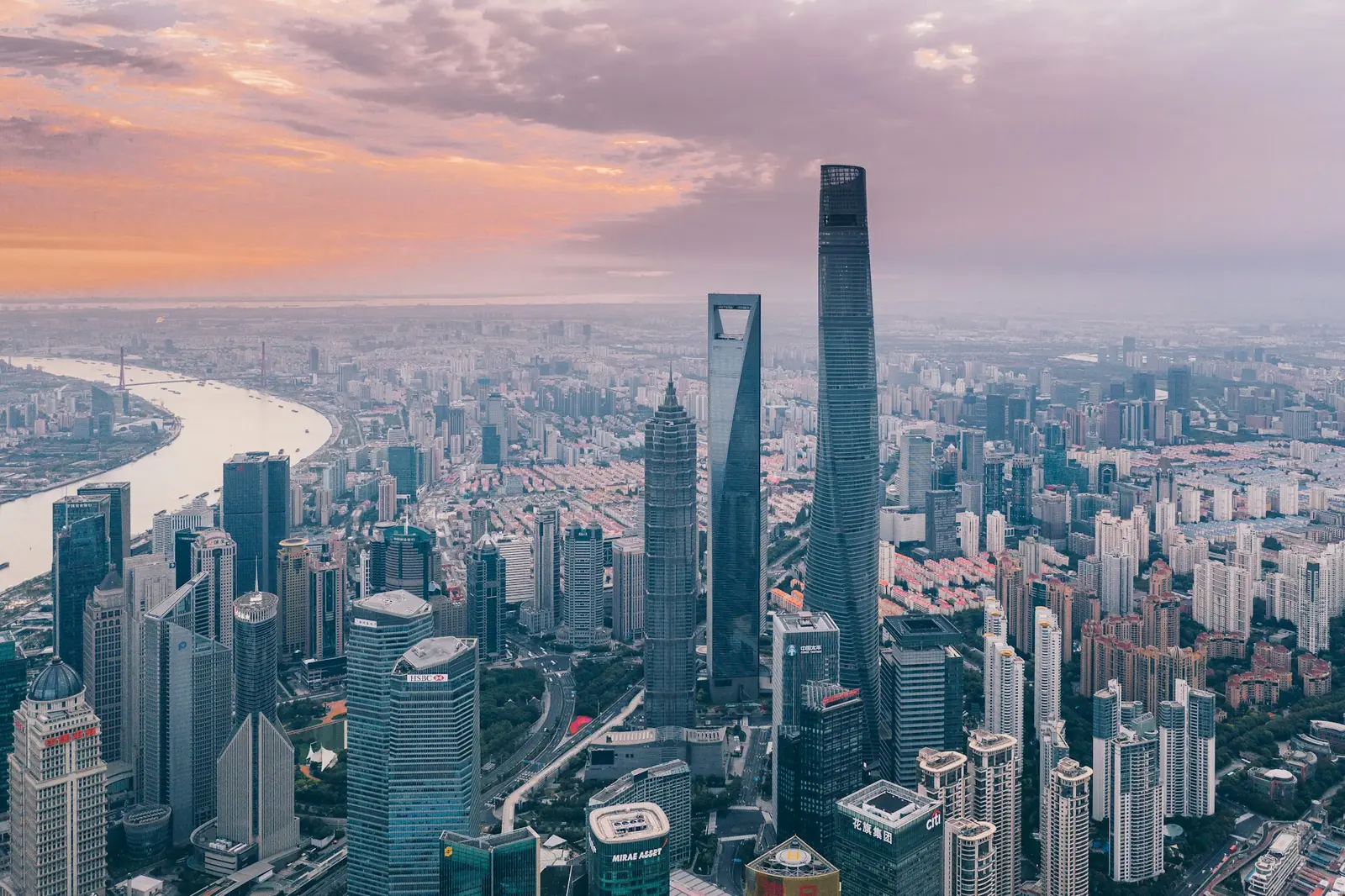
The view changed decisively after 1990, when Pudong was chosen as a spearhead of China’s reform and opening. Fields, docks and low-rise neighbourhoods across the Huangpu gave way to the Lujiazui financial district. The Oriental Pearl Tower, Jin Mao Tower, Shanghai World Financial Center and Shanghai Tower created a new skyline directly opposite the old one.
The contrast was quickly adopted as Shanghai’s signature image: masonry and memory on the west bank, glass and vertical ambition on the east. Yet the relationship is more interesting than “old versus new.” Both shores were built to project financial confidence, only in different political eras and architectural languages.
The promenade itself was rebuilt too. A large 1990s scheme widened the road and strengthened flood defences. Between 2007 and 2010, through-traffic was moved into a two-level tunnel, the surface road was narrowed and more riverside space was returned to pedestrians. The renovated waterfront reopened just before the 2010 Shanghai Expo.
How to read the Bund today
Walk slowly and use the cross streets as chapters. At East Nanjing Road, the Peace Hotel marks the meeting of tourism, commerce and memory. Around Hankou Road and Fuzhou Road, the former banks and trading houses reveal the machinery of the old financial district. At the northern end, Huangpu Park and the meeting of Suzhou Creek and the Huangpu open the story toward the International Settlement’s earliest ground.
The Bund is neither a frozen European streetscape nor a simple symbol of modern China. It is a Chinese urban landscape formed through coerced opening, international commerce, local labour, conflict, state reuse, conservation and mass public life. The best view is not only across the river. Turn around: the façades behind you show how Shanghai has spent nearly two centuries absorbing outside forces and making something unmistakably its own.